All Trees are Sacred- sorta
“All trees are sacred”.
On its face you might think I agree with this statement. However in reality this sentiment is one I see in my community and with many clients that I think is misguided and even in some cases problematic. I understand where this idea comes from and recognize that it is an attempt towards correcting a grievous imbalance. It is a reaction to capitalist-driven ecological destruction of forest lands that has for centuries wiped out old-growth forests and precious ecosystems throughout the world. For far too long in Western colonial society, trees have been treated as simply “resources” to be bought and sold for profit, bereft of any value unto themselves or to the wider ecosystems of which they are keystone species. We have driven the world’s biosphere towards the 6th mass extinction, and logging of the world's forests has been a major factor in this catastrophic event. So I respect the desire to revitalize the world by preserving all the trees. I often say that I’m in the business of cultivating and reviving old-growth forests, which for me are indeed incredibly sacred.
However, in order to get there, we have to weed the garden a bit. “All trees are sacred” implies that every tree is equal, and that we should not cut trees. This sentiment is a literal embodiment of the statement “can’t see the forest for the trees”. As a tree worker, restoration ecologist, and fire practitioner I massacre hundreds of trees on a monthly basis. Young saplings of weedy species like Douglas Fir and Tan Oak that endanger older, slower growing, and established trees are the primary targets of the thinning work I do.
The danger to forest health they present, especially here in California, has several aspects. Doug Firs in particular, because of their vertical growth pattern, will shoot up and break through the canopy of much older Oaks and Madrones that prefer to grow in a wider and more meandering pattern. A mature or old Oak of maybe 60-70 feet can quickly become out-shaded and die by a thicket of much younger Doug Firs if we do nothing and act as if every one of those smaller trees is just as valuable, i.e. “sacred”, as the old Oak. Additionally, these faster growing species increase the odds of a catastrophic fire that can wipe out stands of mature and old growth trees. For millennia, Indigenous peoples have used Good Fire as a tool for keeping the understory clear of excess foliage and promoting a forest ecosystem that supported a wide variety of wildlife and the material needs of the people in a harmonious balance. An excessive understory and/or density of young trees also means less water, nutrients, and light for all trees in question, and further hinders the possibility of returning the forest to old growth status. More trees are not necessarily better trees.
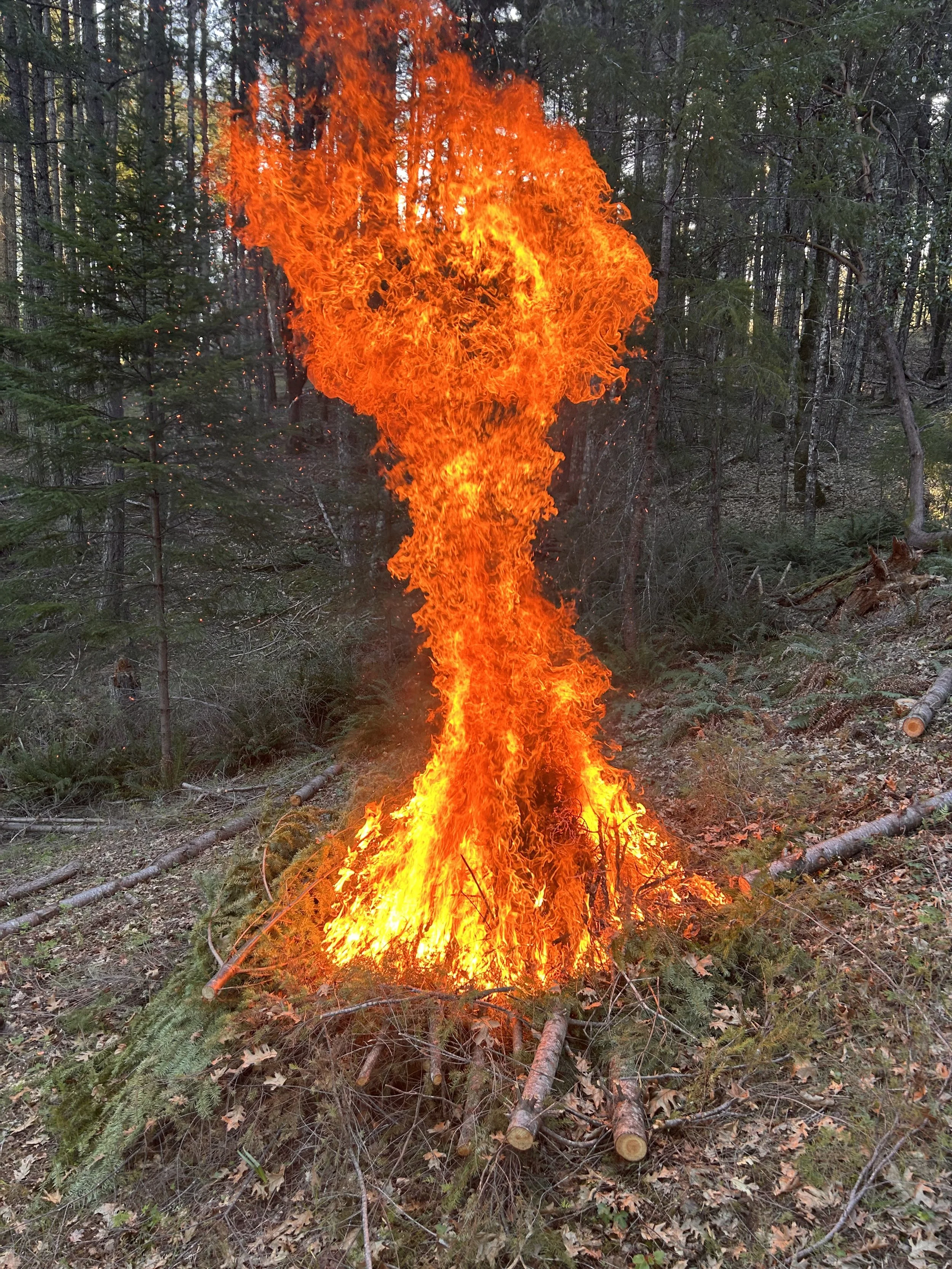
Fire is an essential tool in our kit. It’s also incredibly beautiful and sacred.
A mentor of mine during my college years, Brock Doleman of the Occidental Arts and Ecology Center once put it this way- if you have an acre of trees with 1000 mostly young saplings on it, it is a massive fire danger and unlikely to produce trees of ecological or social value than if that acre has 100 trees on it of mixed age, species composition, and density. When European settlers first arrived in these lands, they often described it as “park-like” and an abundant landscape supporting myriad species in the millions was evident. They mistakenly assumed this was “natural”- as if humans had no hand in it. But we now know that Indigenous peoples, from the Amazonian Basin to the temperate rainforests of the Pacific Northwest had intensive and intentional management strategies based on generations of careful observation that helped to foster these rich landscapes. They did it not through domination and control, but by promoting certain natural cycles and processes that further enhanced the thriving ecologies that they in turn benefited from. And sometimes that meant clearing, cutting, or burning some trees and other plants.
It should be mentioned here that forest thinning means different things to different people. Large forestry operations, especially ones driven by a profit-motive often use the term as a cover for more extractive logging. My stance is that if there is a significant profit-motive behind a thinning operation, it is not going to truly benefit the ecology or return the forest to a pristine and fire-resilient landscape. The type of thinning I promote and work with is aimed at the crowded understory, most of which is not useful in an industrial application like logging. In order to do this at scale however, it requires a robust public funding system which sadly is under attack from the very same capitalist forces that have been destroying these lands for several centuries.
Our society, broadly speaking, is oriented around nature as a resource, rather than nature as something we are a part of and in reciprocal relationship with. We can’t avoid taking from nature for our own material needs. But it is imperative that we give back and maintain a co-existence rooted in mutual aid. Some people would attempt to preserve the forest in their own back yard untouched, while continuing to build structures that take timber and materials from elsewhere under conditions they have no control over. This is a kind of NIMBYism (Not In My Back Yard) that attempts to separate itself from the worst of capitalist society, while actually passively still supporting it. It is my firm belief that people who are not engaged in promoting alternative building practices like cob, strawbale, round-pole timber-frame construction and other sustainable forms of building that use less timber are missing a major part of the conversation about how we protect forests.
To be clear, this isn’t to say we shouldn’t use products from the forest- far from it. My entire career is currently oriented around it. Young Doug Fir trees that threaten older trees of any species, including their own, can be turned into round-pole timber if we adapt to using that as a construction material. A bowl carved from a diseased Tan Oak tree becomes art by revealing mesmerizing swirling patterns where fungi consumed wood, and where black tendrils of Phytopthera ramorum (aka Sudden Oak Death) bit into the trees vital structures. A Doug Fir forest jammed with tiny trees under a good fire management regime becomes fertilizing ash and char for the soil. The smoke from fires inhibits parasitic and pathogenic organisms in the canopy like mistletoe or Phytopthera. There is no “waste” in nature, and we would do well to remember this and embody it in our forestry practices. We can revitalize our forests and highlight their beauty by engaging with them in different ways, rather than leaving them to be after decades of abuse and neglect.
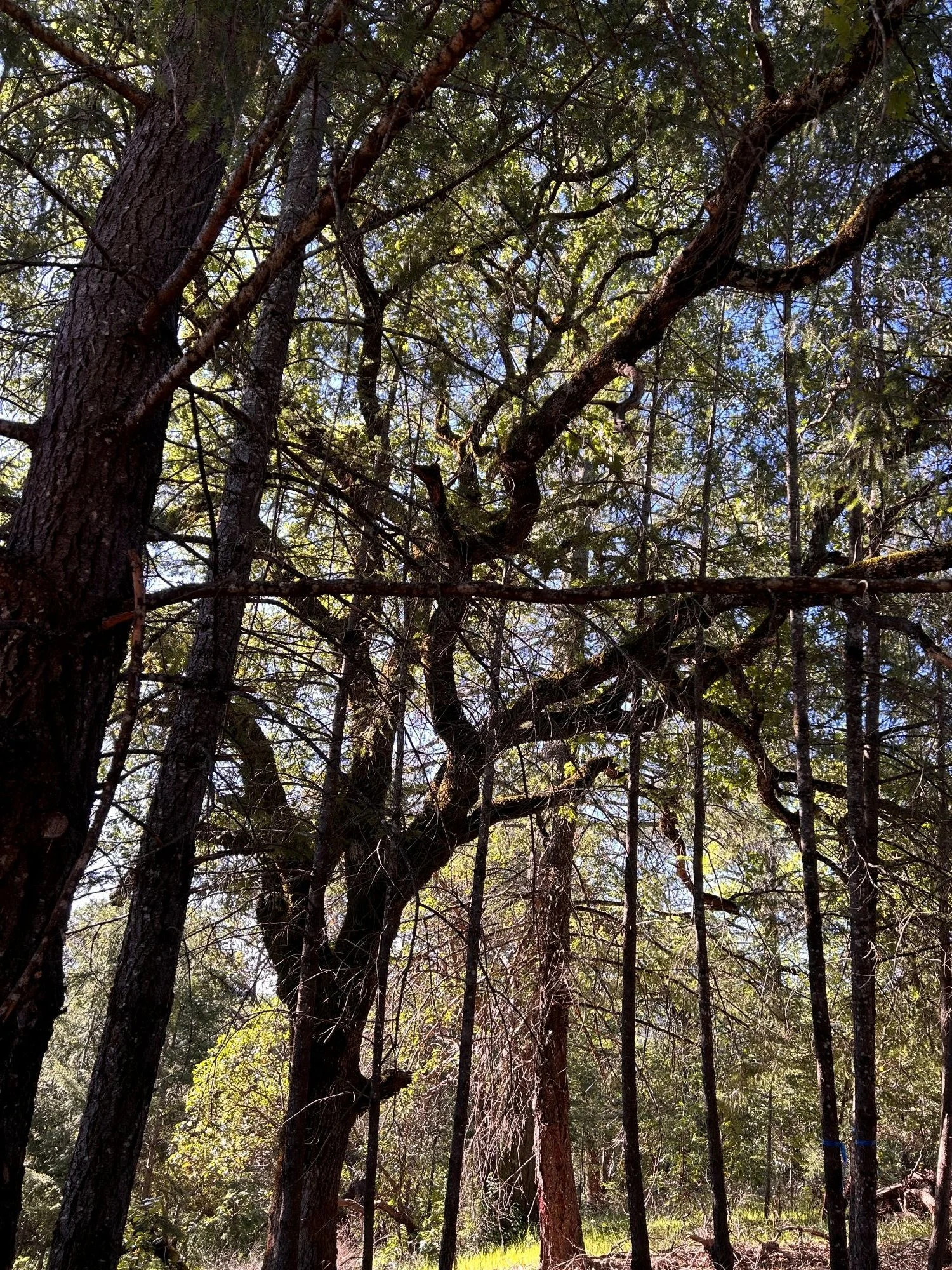
Classic Douglas fir encroachment on Oak savanna (above picture).
A mature Black Oak (squiggly tree) being outshaded by much younger Doug Firs (straight trees) piercing its canopy. This is after much thinning of smaller trees has already occurred. The younger trees in this photo will also eventually be removed for building materials. This is a result of no-management style of management and a timber-driven, fire-suppression forestry culture.
Remains of slash burned for removal (above picture), and intentionally spread out and extinguished early to create useful biochar. Most people who burn piles usually let them burn down to ash, which can also be useful, but I prefer to promote the practice of making biochar which supports a more vital Soil Food Web, and is a form of carbon sequestration. The charred remains are stabilized forms of carbon that don’t decay. Here pictured with a neighbor who helped me with the burn pile while meditating with the fire.
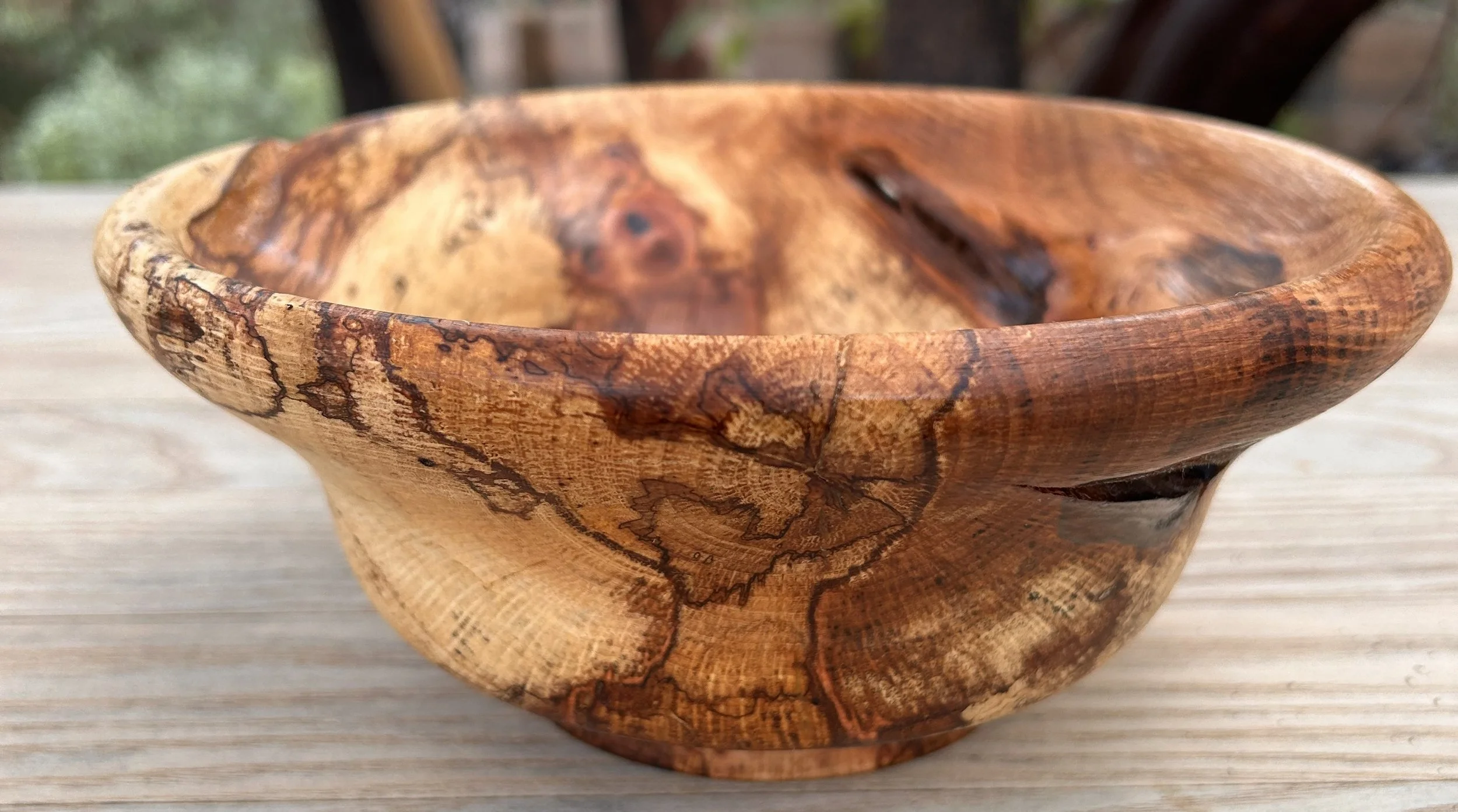
“Sudden Oak Life Bowl” now on display in the Corner Art Gallery in Ukiah, CA.
I carved this bowl from a diseased Tan Oak fallen during a fuels reduction and forest revitalization project. The tree was infected with Pytopthera ramorum (Sudden Oak Death) and prior to carving had also sprouted Oyster Mushrooms. Like Douglas Fir, Tan Oaks can be a weedy species that are very flamable and were crowding another Black Oak grove of much older established trees.